Soft skills training
Developing communication and interpersonal relations in the workplace.
Explore our full catalogue of soft skills training, devoted to communication, interpersonal relations, management and personal development, anywhere in France.
Each module is designed to strengthen your relational skills and your professional impact, and comes with a digital booster module to sustain the effects of the training over time.
We also offer a skills assessment, individual support for career development.
We build the training path that fits you
Beyond our catalogue, we design training paths built entirely around your challenges, your teams, your company culture and your objectives on the ground.
That is where we are at our best : turning a specific need into a training experience that is concrete, useful and immediately applicable.
We draw on a network of some forty experienced trainers across France, able to travel directly to the client (Paris, Lyon, Marseille…) to run sessions as close as possible to your teams.
28 modules
Communication and interpersonal relations
3 modules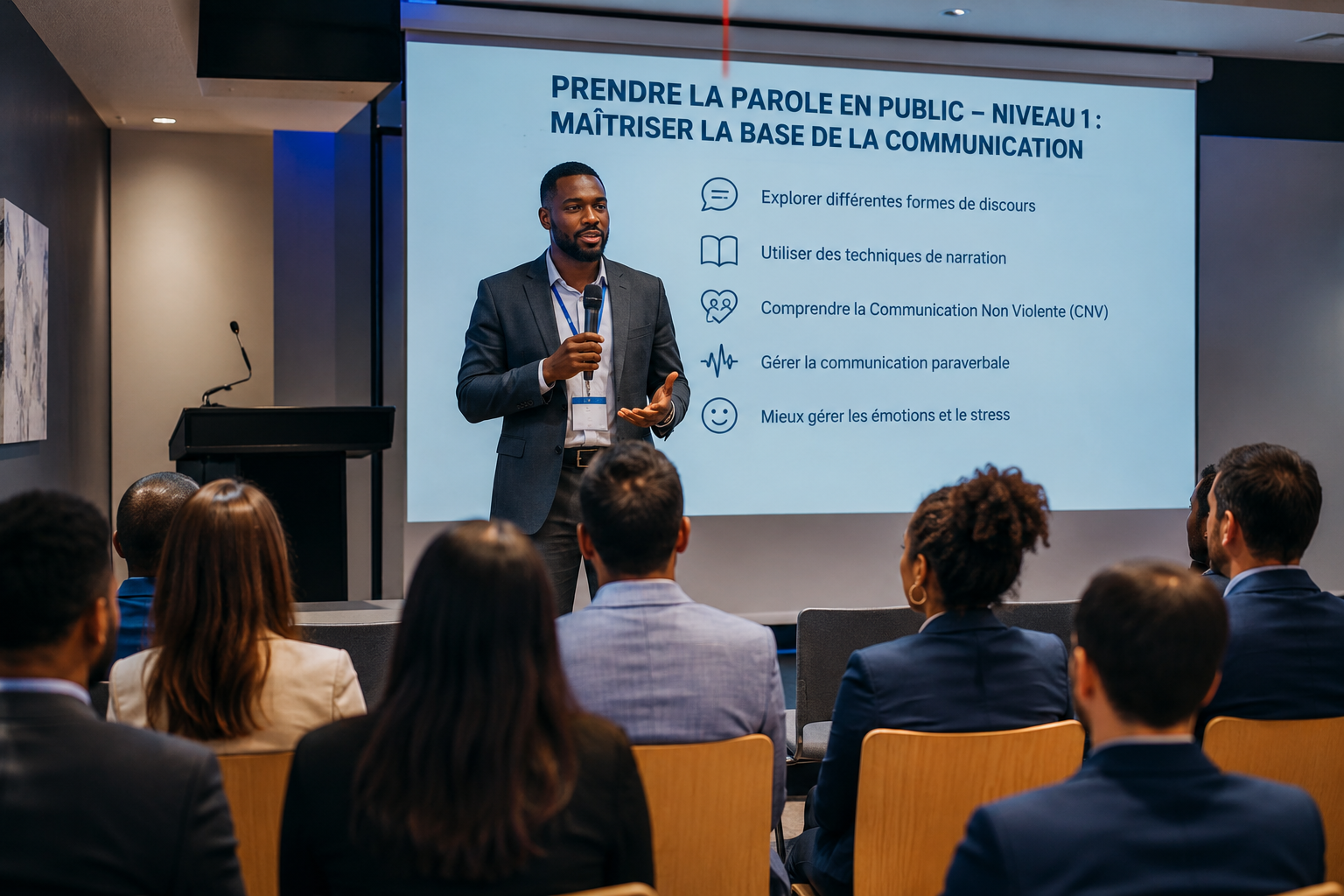 2 daysPublic speaking — Level 1See the objectives
Objectives
- Master the fundamentals of communication
- Explore different forms of speech
- Use storytelling techniques
- Understand Nonviolent Communication (NVC)
- Manage paraverbal communication
- Handle emotions and stress better
 2 daysManaging conflict: preventing and resolving disputesSee the objectives
Objectives
- Determine the nature of workplace conflicts
- Develop interpersonal skills
- Strengthen your emotional intelligence
- Build a conflict-resolution strategy
- Cultivate assertiveness in the workplace
- Apply NVC day to day
 2 daysCommunicating with tact and flexibilitySee the objectives
Objectives
- Assert yourself tactfully in conversation
- Adapt effectively to the person in front of you
- Move from the emotional to the factual in what you say
Remote communication and self-image
3 modules 2 daysPerforming when you speak remotelySee the objectives
Objectives
- Recognise the fundamentals of NVC in remote settings
- Identify the fundamentals of speaking remotely
- Apply paraverbal signals accurately
- Practise eye contact with the camera and framing
- Determine the precise objective of your intervention
- Prepare your on-camera intervention
- Set up a climate that encourages exchange
- Practise techniques that foster interaction
 2 daysBuilding a positive self-image in order to act with confidenceSee the objectives
Objectives
- Recognise your qualities and skills to strengthen your self-assessment
- Analyse your areas for improvement
- Identify your beliefs in order to reshape them (growth mindset)
- Develop coping strategies for failure and criticism
- Recognise the obstacles to effective communication
- Apply assertive communication techniques (needs and opinions)
- Set clear, measurable personal objectives
- Put self-motivation strategies into practice (perseverance)
 1 dayMedia training: succeeding in media appearancesSee the objectives
Objectives
- Identify how journalists work
- Interact with them effectively
- Prepare your interview and get in the right frame of mind
- Handle every type of interview, with personalised debriefing
- Answer a live broadcast interview (role play)
- Succeed in a recorded interview (role play)
- Adapt your answers to the medium and the format
- Decode and optimise non-verbal language
- Understand the effect of editing
Active listening and everyday communication
3 modules 2 daysImproving your communication through active listeningSee the objectives
Objectives
- Identify barriers to listening and what is at stake in the relationship
- Determine the levers of effective communication and listening
- Practise empathy in communication
- Experience non-verbal synchronisation
- Analyse your communication style
- Apply a constructive stance in your daily exchanges
- Identify defence mechanisms and resistance
- Develop effective, considerate coping strategies
 2 daysPublic speaking — Level 2See the objectives
Objectives
- Analyse your emotions and their influence on communication
- Develop techniques to express your emotions authentically
- Apply the verbal and non-verbal techniques of persuasive communication
- Draw on your personal style and creativity
- Create positive communication
- Design interactive presentations
- Interpret your audience’s emotional reactions
- Use emotional feedback constructively
 2 daysImproving your everyday communicationSee the objectives
Objectives
- Spot your communication habits
- Analyse your recurring relational patterns and their effects
- Structure your messages and express your requests (assertive language)
- Put active listening techniques into practice
- Distinguish your interpretive filters to clarify your perceptions
- Choose channels and modes of communication suited to the situation
- Use a structured method for managing relational tension
- Assess your reactions to disagreement and cooperate
Adapting your strategy, and theatre techniques
3 modules 2 daysAdapting your communication strategy to the situationSee the objectives
Objectives
- Examine difficult situations and what is at stake in the relationship
- Identify your role and your levers in complex situations
- Handle tense situations with judgement
- Formulate a request — and a refusal — effectively
- Practise the art of constructive criticism
- Receive criticism positively
- Handle conflict effectively
- Negotiate win-win solutions
 2 daysPublic speaking using theatre techniquesSee the objectives
Objectives
- Analyse how you inhabit your body and the space around you
- Manage stage fright in front of an audience
- Analyse and optimise the impact of your voice
- Experience and master non-verbal language
- Handle the unexpected with agility
- Innovate by daring to interact and answering to the point
- Examine the different facets of yourself
- Develop a positive mindset on stage
 2 daysCommunicating better with Process CommunicationSee the objectives
Objectives
- Build constructive, fluid relationships
- Develop your role in listening to and coordinating the team
- Prevent conflict day to day
- Manage interpersonal tension using personality profiles
NVC, high-impact communication and relationships
3 modules 2 daysUsing the principles of NVC to defuse tensionSee the objectives
Objectives
- Identify the filters that distort the perception of reality
- Practise observation without judging or interpreting
- Apply the four steps of the NVC process
- Use positive language for dialogue within the company
- Practise active listening in the face of obstacles
- Express your needs without projecting them onto others
- Formulate clear requests that are not demands
- Apply emotional intelligence to manage your feelings
- Redefine and manage conflict within the company
 2 days5 tools for high-impact communicationSee the objectives
Objectives
- Acquire the attitudes that increase the impact of your communication
- Adapt your mode of communication to the person in front of you
- Develop and gain relational agility day to day
 2 daysBuilding positive relationships at workSee the objectives
Objectives
- Distinguish relationship from communication
- Detect what is at stake and where each person’s responsibility lies
- Identify communication filters in order to step back
- Determine the role of emotions in order to regulate them better
- Name and overcome your inhibiting mechanisms
- Express your point of view while keeping the connection
- Apply active listening to build connection
- Integrate feedback to increase your performance
- Detect the mechanisms of conflict in order to prevent it
Improving your relational skills and the art of questioning
3 modules 2 daysImproving your communication and your relationshipsSee the objectives
Objectives
- Adapt your communication to the profile of the person in front of you
- Develop assertive behaviour in your interpersonal relations
- Strengthen your powers of persuasion to give your ideas more impact
- Speak with ease in the different kinds of intervention
- Learn to work around deadlock
 2 daysDeveloping your relational effectiveness through active listeningSee the objectives
Objectives
- Improve your relational effectiveness in a range of communication situations
- Understand the psychological foundations of active listening
- Choose the right communication channels to optimise exchanges
- Synchronise with the other person for fluid communication
- Use active listening tools in professional interviews
 2 daysQuestioning in order to understand, persuade and decideSee the objectives
Objectives
- Question in order to create an interactive, constructive exchange
- Learn to get people talking in order to reach your objectives
- Question methodically in order to progress, persuade and decide
- Adopt a genuine listening attitude in order to question better
- Handle the delicate questions that affect the quality of the relationship
Difficult situations, personal development and self-knowledge
3 modules 2 daysCommunicating in difficult situationsSee the objectives
Objectives
- Identify the mechanisms that trigger or sustain a difficult situation
- Adapt your spoken and written communication to prevent or reduce tension
- Express your needs clearly while regulating your emotions
- Handle disagreement, criticism or conflict constructively
- Conduct a delicate conversation while preserving the professional relationship
 2 daysA 360° overview of personal and relational developmentSee the objectives
Objectives
- Regulate your emotions to better understand their effect on your decisions
- Adapt your response to stress to preserve your effectiveness in key moments
- Develop conscious communication to prevent misunderstandings
- Assert yourself appropriately within your working environment
- Strengthen the quality of your professional relationships (cooperation and trust)
 2 daysKnowing yourself better in order to interact better with othersSee the objectives
Objectives
- Identify your processes of learning, change and communication
- Identify your deep sources of motivation
- Control your reactions in the light of your emotions and those of others
- Use your emotions to clarify situations and exchanges
- Adopt an adult, composed stance in all circumstances
- Communicate your needs through inclusive communication
- Put cooperative behaviours into practice
- Develop your leadership in the service of the collective
Resilience, stress and professional creativity
4 modules 2 daysBuilding resilience and drawing on your resources to bounce backSee the objectives
Objectives
- Act concretely on the levers of individual and collective resilience
- Define and clarify the meaning of what you do every day
- Act positively in the face of obstacles and adversity
- Anticipate your stress in order to protect yourself over the long term
 2 daysAdopting new reflexes under stressSee the objectives
Objectives
- Identify how stress works, its benefits and its limits
- Change the automatic thoughts that generate stress
- Decode and understand your emotions in order to regulate them better
- Change your behavioural habits under pressure
- Use assertiveness to stand your ground calmly in any situation
- Communicate your deeper needs in order to regulate stress
- Apply preventive measures in your professional day-to-day
- Use effective relaxation techniques
 2 daysDeveloping your creativity in professional lifeSee the objectives
Objectives
- Recognise your personal creative profile
- Decode the psychological mechanisms limiting your creativity
- Support and value every idea in the working group
- Build an open, safe and dynamic working environment
- Favour quantity over quality in order to think outside the box
- Reframe the problem from another angle
- Evaluate and refine a team’s ideas intelligently
 1 dayFlash course — Being dynamic, positive and more effectiveSee the objectives
Objectives
- Integrate the psychological mechanisms of self-motivation and optimism
- Develop your personality and consolidate your model of exemplarity
Emotions, negotiation and expert stance
3 modules 2 daysManaging your emotions in any situationSee the objectives
Objectives
- Measure your emotional quotient to locate yourself better
- Examine the cognitive mechanism of strong emotions
- Apply mindfulness and breathing techniques
- Use effective mental reframing techniques
- Develop empathy through the recognition of emotions
- Express your emotions and needs clearly in a crisis
- Handle immediate emotional tension with perspective
- Apply proven conflict-resolution strategies
 2 daysNegotiating and persuading — arguing with impactSee the objectives
Learning objectives
By the end of the course, participants will be able to:
- identify their communication reflexes;
- practise active listening and spot the needs of the person in front of them;
- build arguments oriented towards value, benefits and evidence;
- structure a clear, persuasive line of argument;
- anticipate and handle objections methodically;
- assert themselves and respond to remarks;
- adapt their communication to the profile of the person in front of them;
- maintain a calm, professional stance.
Find out more — full programme
Programme summary
- Dates
- 4 and 5 March 2026
- Duration
- 14 hours – 2 days
- Hours
- 9.00–12.30 and 13.30–17.00
- Format
- on site – in-house
- Venue
- Camp'Atlantique, 4 rue Auguste Herbert, 85560 Longeville-sur-Mer, France
- Contracting body
- INSAHO – SAS AXIONCOM
- Subcontractor
- Wake Up Inside
- Trainer
- Francis Rosales
Who it is for
Anyone who has to defend an idea, put forward a proposal, persuade an individual or a group, answer objections and win agreement.
In the Camp'Atlantique context, the course is aimed at staff dealing with customers or with internal and external contacts.
Prerequisites
None.
Participants are invited to draw on real professional situations involving negotiation, persuasion or handling objections.
Teaching team
Francis Rosales – Wake Up Inside delivers the sessions and handles the adaptation of exercises, the role plays, the teaching feedback and the assessment of learning.
INSAHO – SAS AXIONCOM handles administration, invitations, logistics and the transmission of the necessary documents.
Teaching resources and equipment
The course alternates targeted input, guided discussion, self-assessment, individual exercises, work in pairs and small groups, case studies, role plays and trainer feedback.
Resources include a course handbook, tool sheets, observation grids, case studies, a projector or screen, a computer and a flipchart or whiteboard.
Detailed programme
Day 1 — Communicating effectively and building a solid argument
Welcome, introduction and scoping of the course
This session sets out the framework of the course, gathers participants’ expectations and identifies their main professional situations.
The topics covered are:
- presentation of the objectives and the programme;
- presentation of the teaching and assessment methods;
- gathering expectations;
- identification of the professional situations encountered;
- initial self-assessment.
Session 1 — Locating yourself in your own communication
This session helps participants better understand the way they communicate and their main relational reflexes.
The topics covered are:
- the main modes of communication;
- relational habits and behaviours;
- differences of perception between sender and receiver;
- the possible gap between intention and effect;
- identifying your strengths and areas for progress.
Practical work:
- self-assessment;
- analysis of professional situations;
- discussion in pairs.
10 h 45 – 11 h 00 — Break
Session 2 — Understanding the other person through active listening
This session helps participants identify the real needs and motivations of the person in front of them.
The topics covered are:
- the principles of active listening;
- the different types of question;
- paraphrasing and checking understanding;
- explicit and implicit needs;
- the other person’s motivations;
- the main barriers to listening;
- verbal and non-verbal signals.
Practical work:
- questioning practice;
- paraphrasing exercises;
- role plays in pairs.
12 h 30 – 13 h 30 — Lunch break
Session 3 — Building a benefit-led argument
This session helps participants build arguments that are clear, concrete and matched to the expectations of the person in front of them.
The topics covered are:
- the difference between feature, advantage and benefit;
- the notion of perceived value;
- building a solid argument;
- the use of evidence and examples;
- ranking arguments in order of importance;
- matching the argument to the need identified.
Practical work:
- analysis of existing arguments;
- turning features into benefits;
- writing a sales argument.
15 h 00 – 15 h 15 — Break
Session 4 — Anticipating objections and answering them
This session helps participants identify foreseeable objections and build suitable answers.
The topics covered are:
- the different types of objection;
- telling a genuine objection from a pretext;
- receiving and clarifying the objection;
- paraphrasing;
- looking for the underlying need or fear;
- building a reasoned answer;
- checking the answer has landed.
Practical work:
- case study;
- practice in pairs;
- writing up professional answers.
Summary and consolidation of day 1
This session consolidates what has been learned during the day and prepares its application.
The topics covered are:
- summary of the key concepts;
- review of the difficulties encountered;
- identification of the directly applicable tools;
- writing up concrete actions;
- preparation for day 2.
Day 2 — Persuading, asserting yourself and winning agreement
Reactivation of day 1
This session reactivates the previous day’s content and checks it has been understood.
The topics covered are:
- communication reflexes;
- active listening;
- questioning and paraphrasing;
- identifying needs;
- building an argument;
- the first steps in handling objections.
Practical work:
- oral quiz;
- group discussion;
- correction and restatement of the key concepts.
Session 5 — Structuring a persuasive argument
This session helps participants organise their argument logically and convincingly.
The topics covered are:
- the stages of a reasoned exchange;
- the opening and the discovery of the need;
- paraphrasing;
- choosing arguments and sequencing them;
- presenting benefits and evidence;
- anticipating objections;
- closing and checking agreement.
Practical work:
- co-building an interview framework;
- preparing a sales argument;
- practice in pairs.
10 h 45 – 11 h 00 — Break
Session 6 — Standing your ground in a delicate situation
This session helps participants keep a professional stance when the exchange becomes more complex or more tense.
The topics covered are:
- reactions under stress;
- defence mechanisms;
- the difference between assertiveness, aggression and passivity;
- the principles of assertiveness;
- handling difficult remarks;
- stepping back;
- paraphrasing under tension;
- holding the frame of the exchange.
Practical work:
- analysis of delicate situations;
- paraphrasing exercises;
- role plays;
- practice in arguing under pressure.
12 h 30 – 13 h 30 — Lunch break
Session 7 — Adjusting your communication to the person
This session helps participants adapt their communication to the profile and expectations of the person in front of them.
The topics covered are:
- frames of reference;
- relational profiles;
- communication preferences;
- verbal and non-verbal signals;
- adapting vocabulary, tone and pace;
- choosing arguments according to the person;
- checking understanding.
Practical work:
- profile analysis;
- adapting what you say;
- contextualised role plays.
15 h 00 – 15 h 15 — Break
Session 8 — Answering objections calmly
This session helps participants apply a structured method for handling objections.
The topics covered are:
- barriers to communication;
- objections relating to price, lead time, need, trust or competition;
- listening and clarifying;
- paraphrasing;
- looking for the real cause;
- the reasoned answer;
- using evidence or an alternative;
- checking agreement and closing the exchange.
Practical work:
- role plays;
- work on real situations;
- peer observation;
- trainer feedback.
Final assessment and close of the course
This session assesses what has been learned and prepares its application at work.
The topics covered are:
- final role play;
- building an argument;
- handling an objection;
- trainer feedback;
- final self-assessment;
- comparison with the initial self-assessment;
- drawing up an action plan;
- satisfaction questionnaire.
Arrangements for monitoring delivery
Delivery of the course is monitored through:
- attendance sheets signed for each half-day;
- the trainer’s presence on both days;
- participation in the exercises;
- individual and group output;
- the role plays;
- the observation grids;
- the trainer’s report;
- the satisfaction questionnaires.
For on-site courses, the attendance sheets are the main record of attendance.
Arrangements for assessing results
Initial assessment
- gathering expectations;
- self-assessment against the target skills;
- identification of the professional situations encountered;
- discussion to gauge the starting level.
Assessment during the course
- oral questioning;
- observation of the exercises;
- analysis of the arguments built;
- case studies;
- role plays;
- trainer feedback;
- group correction.
Final assessment of learning
The final assessment is a role play in which the participant must:
- discover the other person’s need;
- build a suitable argument;
- highlight a benefit and supporting evidence;
- answer an objection;
- maintain a professional stance;
- check agreement or propose a next step.
Final self-assessment
Each participant rates their level of mastery at the end of the course and compares it with their initial self-assessment.
Satisfaction assessment
A questionnaire separate from the assessment of learning is completed at the end of the course.
Accessibility for people with disabilities
Any adjustment needs must be identified before the course begins.
A conversation is arranged with the participant or the client in order to identify functional needs and possible adjustments.
Performance indicators
The performance of the course is tracked using the following:
- participant attendance rate;
- participation rate in assessments;
- extent to which the learning objectives were met;
- overall satisfaction rate;
- rate at which the course is recommended;
- extent to which the learning is applied at work;
- number of complaints or incidents reported;
- improvement actions decided on the basis of the feedback.
Results are analysed after each session using the attendance sheets, the assessments of learning, the satisfaction questionnaires, the trainer’s report and, where provided for, follow-up questionnaires or client feedback.
 2 daysFrom the stated need to the recommendation: an expert stance on the phoneSee the objectives
Objectives
- set aside their own projections so as to stay within a professional, customer-centred frame;
- strengthen active listening, including while entering data on screen (method + discipline);
- adopt the commercial stance of an expert: frame, reassure, guide and recommend the best solution;
- go beyond the stated need to identify the real one and propose a more relevant solution (service, option, level of comfort), while remaining ethical and credible;
- handle objections (price, comparison, hesitation) without belittling themselves and without stepping outside the frame.

Skills assessment
Personalised support for career development
- Title
- Skills assessment — personalised support for career development
- Duration
- Between 10 and 24 hours, spread over 6 to 8 weeks
- Format
- On site, remote or hybrid — individual sessions of 1½ to 2 hours
Legal framework. The skills assessment is carried out in accordance with article L.6313-4 of the French Labour Code.
It comprises three compulsory phases: a preliminary phase, an investigation phase and a conclusion phase.
Who it is for, and prerequisites
Employees in the private or public sector, jobseekers, self-employed workers, people changing career, and older workers preparing a professional transition.
No specific prerequisites.
The process is entirely voluntary.
Learning objectives
By the end of your skills assessment, you will be able to:
- identify your professional and personal skills;
- identify your aptitudes, values and motivations;
- analyse your career path;
- spot your resources and what holds you back;
- explore different professional avenues;
- validate a realistic career plan and, where appropriate, a training plan;
- draw up an operational action plan to put your project into practice.
Find out more — programme, methods and arrangements
Programme
Preliminary phase (2 to 3 hours)
Objective: to analyse the request and define the objectives of the assessment.
- Analysis of expectations and needs
- Presentation of the process and the methods
- Definition of personalised objectives
- Information on the confidentiality of the discussions
Investigation phase (10 to 15 hours)
Objective: to analyse the profile and explore professional avenues.
- Analysis of the career path
- Identification of transferable skills
- Analysis of values, motivations and professional interests
- Career guidance and personality tests
- Exploration of occupations and sectors
- Analysis of the labour market
- Feasibility study of the projects
Conclusion phase (4 to 6 hours)
Objective: to formalise the career plan and define an action plan.
- Summary of the assessment findings
- Validation of the career plan
- Identification of the steps needed to carry out the plan
- Drawing up a personalised action plan
- Handover of a summary document to the beneficiary
Post-assessment follow-up (optional)
A follow-up conversation may be offered at 3 or 6 months in order to assess how the career plan is being carried out.
Supervision
The assessment is carried out by a career development consultant / skills assessment consultant with professional coaching expertise.
Methods used
The individual support draws on:
- Individual interviews
- An analysis of the career path
- Self-assessment questionnaires
- Professional interest and personality tests
- Introspection exercises
- Desk research and occupational enquiries
- The joint building of the career plan
Teaching materials, analysis sheets, digital tools for remote work, and documentary resources on occupations and training.
Assessment arrangements
- Self-assessment by the beneficiary throughout the process
- Progressive validation of the career plan
- Satisfaction questionnaire at the end of the assessment
Deliverables given to the beneficiary
- Summary document of the skills assessment
- Personalised action plan
Arrangements and lead times
On simple request to WAKEUPINSIDE, a first conversation is offered in order to analyse needs and set a suitable timetable.
The programme starts within 15 days of acceptance of the quotation, subject to availability and to signature of the agreement.
Prices
On quotation, according to the request made.
Accessibility for people with disabilities
WAKEUPINSIDE takes care to make its programmes accessible.
Contact us so that we can look together at the possible adjustments — organisational, educational or material — that would allow the skills assessment to take place.
Contact
- Contact person
- Mr Francis ROSALES
- Téléphone
- 06 63 46 12 80
- Address
- 34 rue Étienne Dolet, 94100 Saint-Maur-des-Fossés, France
WAKEUPINSIDE — SAS with share capital — 34 rue Étienne Dolet, 94100 Saint-Maur-des-Fossés, France — SIRET: 982 993 925 00022.
Activity declaration registered under number 11941427894 with the Prefect of the Île-de-France region.
“This registration does not constitute State approval.”
How it works
Every assignment starts with a scoping conversation.
We have no catalogue to sell you, we have a context to understand.
On site or remote
Our trainers travel straight to your premises, anywhere in France.
Remote delivery is offered when it serves your teams better.
Digital booster module
Every course comes with a digital module that extends the effects of the session once participants are back at their desks.
A reply within 48 h
The detailed programme — objectives, schedule, assessment methods, price — is sent to you within two working days of the scoping conversation.
Our training is accessible to people with disabilities: contact us beforehand so we can work out the adjustments needed together.
Our services may be covered by your OPCO, and we will help you put the funding application together.
Not quite finding what you are looking for?
That is often a good sign.
The needs that fit none of the catalogue’s boxes make for the most useful programmes.
Tell us what you want to change in your teams, and we will build the rest.